
The “2026 is the New 2016” trend
By Janelle Ama Nyameye Ackom, Staff Writer
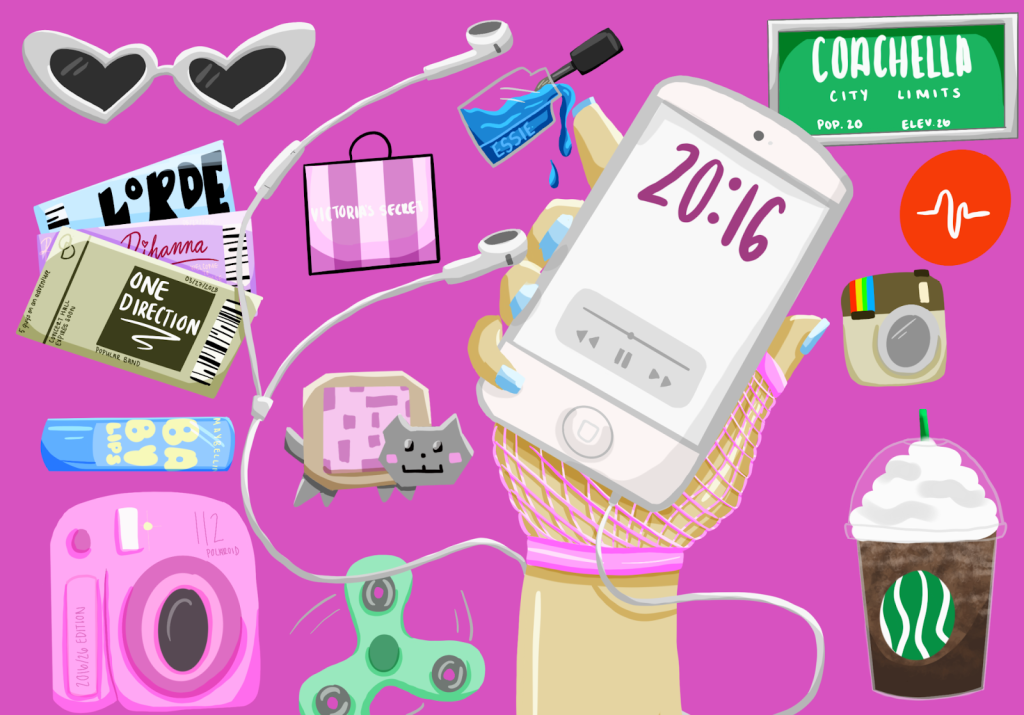
Photo source: The Minnesota Daily
One evening over the winter break, a family friend declared to my sister and me that he would be willing to endure 2020 on repeat if it meant that 2016 would also come around again. I had wholeheartedly agreed, and evidently, we weren’t alone.
At the tail-end of 2025, a trend was conceived: online creators began fervently wishing for and declaring 2026 as the new 2016. With the arrival of the new year, the “2026 is the new 2016” trend really blew up, with online users, influencers, and celebrities such as Charlie Puth, Malala, Hailey Bieber, John Legend, Reese Witherspoon, Kylie Jenner, Mindy Kaling, and Eva Longoria, hopping on board.
What exactly is this trend, you may ask? It consists of posting throwback photos from 2016 on social media. Think video compilations of images representative of the year’s aesthetic (such as oversaturated photos of palm trees, people throwing up peace signs, pictures with the Snapchat dog filter, etc.); participating in trends such as the bottle flip challenge; and sporting high-wasted skinny jeans and chokers to the musical backdrop of hits such as “Lean On” by DJ Snake and Major Lazer, “Starboy” by The Weeknd, and “Love Yourself” by Justin Bieber.
The sheer momentum of the trend is embodied by Spotify statistics depicting a 71% increase in “2016” playlists by late 2025 compared to the previous year, with popular artists from the era making a comeback. This has benefitted artists such as Zara Larsson, whose 2016 song “Lush Life” went viral late last year, and who has embraced a style partly influenced by 2016-esque fashion and makeup aesthetics of vivid colours and maximalism.
Currently, the tag #2016 has been used in over 38 million posts on Instagram and over 1.7 million posts on TikTok. But what about 2016 in particular is being collectively remembered as so great?
The new trend is ultimately fuelled by nostalgia, with many online pining for and reminiscing on 2016 as a simpler, happier, pre-pandemic time, a beacon of light compared to the divisiveness of today. On the social media side, people also associate the era with less performativity and algorithm fatigue.
Additionally, for some, part of the reason online users seek the nostalgia of 2016 so intently may be because it was a year of Western cultural significance. Hamilton swept the Tony Awards, garnering 11 wins—including for best musical. The first season of the hit tv show Stranger Things premiered on Netflix; the series recently concluded with a fifth and final season. Beyoncé released her critically-acclaimed album Lemonade, featuring the hit track “Sorry,” with its famous lyric about “Becky with the good hair.” The Chainsmokers released their hit song “Closer,” a collaboration with Halsey, which has become a popular song choice for “2026 is the new 2016” posts.
The mannequin challenge was also taking over social media, with people, friend groups, and celebrities freezing in place for several seconds and sharing photos and video clips of the results online. We also saw the rise of the water bottle flip challenge, which was inspired by a high school student’s performance at his talent show.
Indeed, judging through the lens of nostalgia, 2016 seems to have been the best experience. But how much of our memory is being warped by nostalgia?
2016 may have had its peaks, but it had its ravines as well. As a matter of fact, at the time, it was being coined as the worst year ever, and the phrase “F*** 2016” was trending on social media. Such rage bloomed from factors such as an increase in racism and anti-immigrant sentiment that spurred Brexit and Donald Trump’s first election; a concerning Zika outbreak; terrorist attacks in Burkina Faso, Turkey, France, Germany and Belgium; and the untimely deaths of celebrities such as Prince, David Bowie, Alan Rickman, Gene Wilder—among other world events.
This begs the question: how did 2016’s public image go from “the worst year ever” to the best?
According to Faye Cooper, journalist and former Vogue editor of culture and fashion, the new trend reflects a broader cultural mood. She highlights that nostalgia has been trending for a while now, evident in “reboots of TV shows and people remaking movies.”
On the topic of 2016 in particular, psychologist Clay Routledge, a specialist in the study of nostalgia, hypothesizes that although political events of 2016 may have elevated existing divisions, other aspects of the year hold nostalgic power because they act as “markers,” i.e., points in time which people anchor themselves to for guidance. The dawn of another new year, against the backdrop of many young people feeling uncertain about the future and dissatisfied with the present, is likely a factor fuelling the obsession with 2016, as nostalgia blooms in periods when the world feels like it’s going through some major change. As Routledge mentions, “When generations are going through…upheaval or [a] kind of challenge, they tend to look back to their youth for comfort and for inspiration, for guidance.”
For me, this explanation feels the most resonant. I was a ten-year-old, phoneless, and digitally-restricted sixth grader in 2016—I honestly wasn’t too in the loop with internet culture. When I think of 2016, fidget spinners, heelies, bottle flips, the “pen-pineapple-apple-pen” song, the “what’s 9 + 10? 21!” meme, and fun field trips come to mind. I think of the sun, sixth grade being the best primary school year, and playing outside. And while all these things influence my rosy viewing of 2016, I’m surely also influenced by the fact that the next couple of years of my life would feature calamities that, in comparison, make my perception of 2016 glow brighter as a bright marker before a storm.
On a similar note, it’s important to realize that the “2026 is the new 2016” trend is primarily a Gen Z one. In 2016, the youngest member of Gen Z could have been five, while the eldest would have been no older than 21. A lot can happen in ten years, and many of us, as we’ve grown, have, at whatever scale, experienced things whose grimness can, in contrast, intensify the perceived glow of a past time period.
Indeed, as Jessica Maddox, an associate professor of media and cultural studies at the University of Georgia, puts it, while the “2026 is the new 2016” trend is fairly innocent, there’s some “revisionist history going on.”
Nostalgia is complicated, and in the case of the “2026 is the new 2016” trend, the unconscious notion is that by partaking in and consuming the aesthetics of 2016, one may experience the same feelings they had back then: the simplicity and the world’s seeming hopeful brightness commonly associated with youth. But that can never be the case, because of three disappointing realities: we can’t escape our current realities, the utopian picture of 2016 (or any year) never truly existed, and to experience those same 2016 feelings, we would have to revert to a former mindset or version of ourselves that doesn’t account for all that has happened since in our lives.
According to Maddox, the 2016 aesthetic photos also hearken back to “simpler” times because people were less online but simultaneously more together in the spaces they were online. Social media felt more like an actual network or community, and people were more likely to follow the same stories and partake in or make fun of the same trends. Additionally, Maddox hypothesizes that the Western person’s media diet in 2016 was less filled with bad news, either from politics or from constantly being plugged into media, causing people to look back and think the year was easier or better.
This balance of being able to have a good time on the internet and then putting down one’s phone long enough to enjoy actual life has led some to declare 2016 as “the last good year.” Dustin Kidd, a sociology professor and pop culture expert at Temple University, suggests that re-framing the year as the last time things were good “finds comfort in the culture of 2016 as a kind of last moment of joy before the politics of our time overwhelmed the culture.”
With all that said, my family friend’s declaration about being willing to endure 2020 cyclically if 2016 would also recur, perhaps could be the mission statement of the “2026 is the new 2016” trend: capturing the intensity and the power of nostalgia behind it, and the deep Gen-Z dissatisfaction with the current timeline.

