
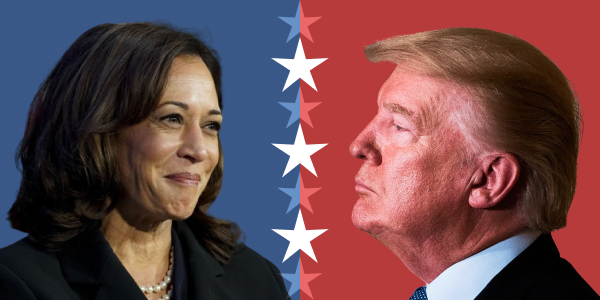
Image source: Elections2024
How the debate has affected their chances in the 2024 U.S Presidential Election
By Ben Outar, Associate Editor
The debate came two months after President Biden dropped out of the race following a disastrous debate with Trump. VP Harris has since been closing the gap in the polls between the Democratic and Republican parties ever since. The month following her selection as Democratic nominee for president, Harris raised a record-breaking $500M in campaign funds and has generally enlivened a previously despondent Democratic platform. Riding the momentum of key endorsements, the successful announcement of Minnesota governor Tim Walz as her running mate, and the bump from the Democratic National Convention, Harris met Trump on the debate stage for what seems to be the only debate of the campaign.
The Debate
Trump and Harris debated topics concerning Americans going into the election, including global conflict, environmental policy, and the peaceful transfer of power. ABC began the debate focused on the economy. The Republican party has centered on this issue, as inflation rates in 2022 hit 9%. Early on, Harris contrasted one of her economic policies, “to give a $50,000 tax deduction to start-up small businesses,” to Trump’s, claiming that he will continue his previous policy of lowering taxes on billionaires. Trump was quick to indicate that he would use a tariff policy, further emphasizing his views on America’s global policy to place them on China and “take in billions” to pay America’s debt.
Addressing border security, Harris was quick to dodge questions at times, choosing instead to bait Trump. When asked about immigration from the Southern border, an issue many regard as deeply mismanaged by the Biden administration due to the rise in border crossings, Harris baited Trump by implying that his rallies were much smaller than hers, saying that “people start leaving his rallies early out of exhaustion and boredom.” Trump took this bait and responded to this attack, diverting attention from her. The topic generated one of many memorable moments, perhaps none more than Trump’s claim that Haitian immigrants in Ohio were “eating [dogs]. The people that came in. They’re eating the cats,” as addressed in Isa Taranto’s article “Who is eating the pets, after all?”

Trump and Harris in Debate, September 10
Image source: Axios
A major concern ahead of the debate was that, despite being Vice President, many Americans felt like l that did not know Harris. One manifestation of this issue was her struggle to differentiate her policies from Biden’s throughout the debate–mainly because, as part of the administration herself, she had to be careful where to critique. This electorally consequential shortcoming is particularly important amongst a Democratic party that just forced Biden out. If undecided voters view Harris in isolation, they could potentially disregard some of the baggage Biden brought to the ticket.
When another key issue, abortion, came up, viewers saw the candidates take their most diametrically opposing stances. Trump, defending a question about his ambiguous abortion stance, falsely stated that the Harris-Walz ticket “says abortion in the ninth month is absolutely fine. [Walz] also says execution after birth [is ok].”
In Biden’s debate with Trump, abortion was a political opportunity he failed to capitalize on. Harris tried to clarify her stance, saying that she would reinstate the protections under Roe v. Wade (1973), a monumental Supreme Court ruling that was overturned in 2022. Stylistically, Trump started similarly to his debate with Biden, not interrupting or raising his voice.
However, unlike Biden, when Harris baited him or attacked him personally, Trump quickly changed tones to something reminiscent of his debates with Hillary Clinton in 2016. As with Clinton, Trump has used personal attacks throughout the campaign, most notably his claim that she “happened to turn Black.” But Harris, without the political history of Clinton, was able to adopt a new style, successfully portraying Trump as angry and incoherent. Particularly distinguishing were her facial expressions, which Lisa Lerer of the New York Times analyzed as “[h]er rebuttal.”
Looking forward
The perceived “winner” of the debate usually sees a small polling bump, which Ipsos confirmed as around 1% nationally for Harris. Currently, Ipsos shows a +6 advantage for Harris, but most national polls are between 1% and 4%.
More relevant to the election, however, is performance in key battleground states, most importantly Pennsylvania; American statistician Nate Silver estimates that whoever wins Pennsylvania’s 19 electoral votes has an over 90% chance to win the election. As of the release of this article, Harris is polling ahead of Trump in Pennsylvania by less than 1%.
With the election quickly approaching, the full effect of the debate will become much clearer. Trump’s campaign claims he won the debate, saying his “masterful debate performance tonight prosecut[ed] Kamala Harris’ abysmal record of failure that has hurt Americans for the last 4 years.” In stark contrast, the Harris campaign, along with most American news sources, view her as the winner.
Harris has also publicly appealed for a second debate, a request that Trump has declined. As emphasized by the proceedings of September 10th, every sound bite and opportunity could make all the difference in winning an election with such thin margins and high stakes.

