
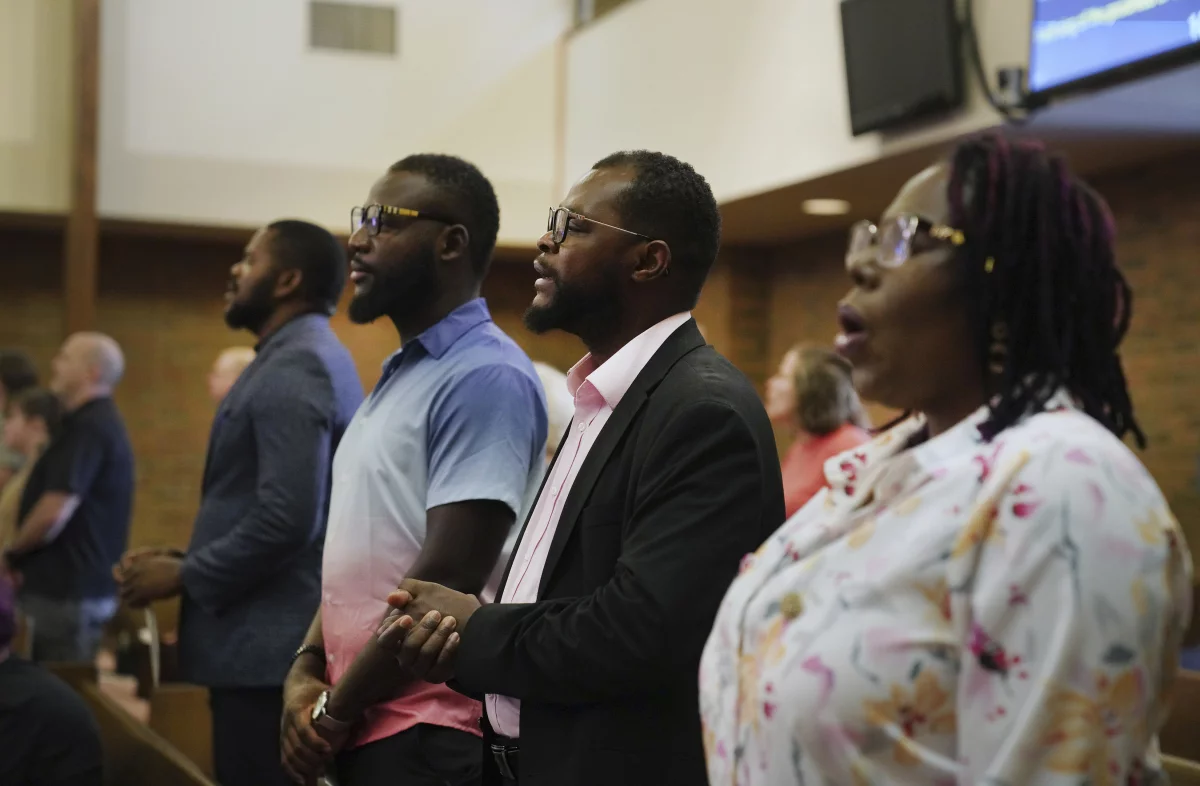
Faced with an increasingly hostile environment, Haitians in Springfield seek solace in one another’s company at church.
Image source: NPR
Implications of targeted discrimination against Haitian immigrants in the US
By Isa Oliveira Taranto, Staff Writer
As the United States presidential election nears, the world holds its breath. Two radically different candidates are competing to control one of the world’s most influential nations at a time in which international relations are particularly strained. What they say now matters deeply, because it offers a glimpse into how the next four years will be for the country and its contribution to the global order.
During the first presidential debate of the campaign, Republican candidate and former President Donald Trump, when asked about immigration and border security, claimed that newly-settled Haitian immigrants in Springfield are “eating the pets of the people that live there.” This accusation comes after the claim went viral on social media and was subsequently echoed by right-wing politicians, including Republican vice-president candidate J.D. Vance. After Trump’s response, the statement was quickly dismissed by the debate host as untrue. Still, in the days following, it remained highlighted in the media as one of the key takeaways from the confrontation.
This recent case of prejudice against the Haitian community in the United States is, unfortunately, one of many. Targeted attacks of this sort have been a constant in recent history, reflecting a legacy of mistreatments and the weaponization of misinformation for the sake of specific political agendas.
A brief history of Haitian discrimination
Haitian history is a tale of resistance and hardship. The Haitian Revolution (1791-1804) gave way to a declaration of independence and the first successful creation of a republic by a formerly enslaved nation. This revolutionary victory empowered many other enslaved populations across the globe to revolt against colonizers.
Nonetheless, the country struggled with internal instability and was eventually subjected to occupation by the United States, both in 1915 and 1994. The first intervention sought to calm the internal unrest of the country, and the U.S. Marines created a professional Haitian military force to do so. This group became the dominant power in national politics throughout the 20th century and, ironically enough, the United States intervened for a second time to dissolve its own creation in 1994, since the military had overthrown the democratically elected government.
In recent years, therefore, Haiti has been left devoid of strong authority. As a result, the country has suffered with the uncontrolled rise of gangs and paramilitary organizations that sought to illicitly and violently fill that power vacuum (The Conversation). UN intervention following the 2010 earthquake provided humanitarian relief after international mobilization, but social instability and poverty continue to impact large percentages of the country’s population.
In 2021, political unrest came to a pinnacle when President Jovenel Moïse was assassinated in a play for power which seems to have included the former prime minister, the former Chief of National police, and Moïse’s widow.
Today, the country is plunged into a state of political unrest and social instability. In April, then-Prime Minister Ariel Henry resigned after armed groups did not allow him to return to the country. The capital, Port-au-Prince, is now primarily controlled by such gangs, and their influence is widespread in other regions of the country, especially due to the power gap left behind by the PM’s exit.
As a response to these dire prospects, many Haitian-born individuals have sought immigration. From the mid-20th century onward, the flow of Haitian immigrants to the United States has been intense, especially due to the brutal nature of Jean-Clade Duvalier’s rule in the 1980s. In recent years, the rate of Haitian population growth has slowed down. Nonetheless, in 2022, almost 731,000 Haitian immigrants resided in the US (Migration Policy). The past four years have seen the settlement of about 15,000 of those immigrants to Springfield, where the allegation of pet-eating arose last month.
Haitian immigrants in the United States have been subject to extensive degradation in public discourse, especially during the AIDS epidemic. The Haitian population immigrating to and residing in the US was stigmatized as a focal point for disease transmission. At a time when ignorance about HIV was still the norm, Haitians in Miami and New York were fired without any reason other than their nationality, and some Americans refused to touch those of Haitian descent.
Haitian asylum-seekers arriving in the United States in the second half of the twentieth century were also subject to a particularly rigorous selection process. Haitian individuals were tested for HIV/AIDS upon arrival. If the results came back positive, the patient was sent to quarantine in Guantanamo Bay, where life conditions were precarious and access to proper medical care nonexistent (U.S. Committee for Refugees and Immigrants).
The current legacy of normalized oppression
The impact of particularly harsh immigration policies,historical misconceptions, and systemic prejudice are felt by Haitians in America to this day. In fact, after the presidential debate, Vance claimed that HIV infections in Springfield “have skyrocketed” in recent years due to Haitian immigration, without providing any data to support that allegation. There were concerns for Springfields public infrastructure when faced with a rapid population increase after the recent arrival of a large population of immigrants; however, the recent immigration wave has helped fill jobs previously vacant because of a labor shortage (NPR). Until governmental institutions adapts to rises in population, it is expected that the city will experience some strain on resources, and Republican Ohio Governor Mike DeWine has stated that they “would like some help from the federal government.”
Vance’s hostility toward a large part of Springfield’s population leaves an unclear prospect of how a potential Trump administration would proceed in terms of providing aid to Springfield’s public institutions. What is clear, however, is that Haitian migrants are not welcomed by his campaign: both Trump and Vance have explicitly stated their intention to conduct the “largest-ever deportation” in United States history if they do take office in 2025.
It is through the belittling of others that some politicians seek strength for themselves. The “they are eating the pets” allegation is dangerous and unfortunately powerful because it creates an antagonist “they”, and consequently an “us” – symbolically tasked with the defense of America’s domesticated animals, but, more importantly, belonging to an imagined group that exists based on the premise of exclusion. The impact of this sort of thinking may be difficult to measure in precise data, but its implications are clear in the lives of countless individuals.
One non-Canadian U of T student has recently been the victim of a racially-driven physical attack in the subway. She expected that an unfortunate event such as this would happen at some point in her immigration journey, but not “so soon and not in a busy city, in broad daylight, so close to a college campus.” It is sad, she said, that she is not “traumatized”, and “not even paranoid.”
Her experience speaks to the banalization of racism even in modern and urban settings such as Springfield and Toronto. In an increasingly globalized world, prejudice is maintained exactly because of the sort of thinking Trump has been stimulating with ill-informed comments.
As the election nears, Haitian immigrants in the United States are left in a delicate position, fearing for their safety, expecting a surge in racially-motivated attacks, and unsure of their status as legal residents if Trump regains the White House.

