
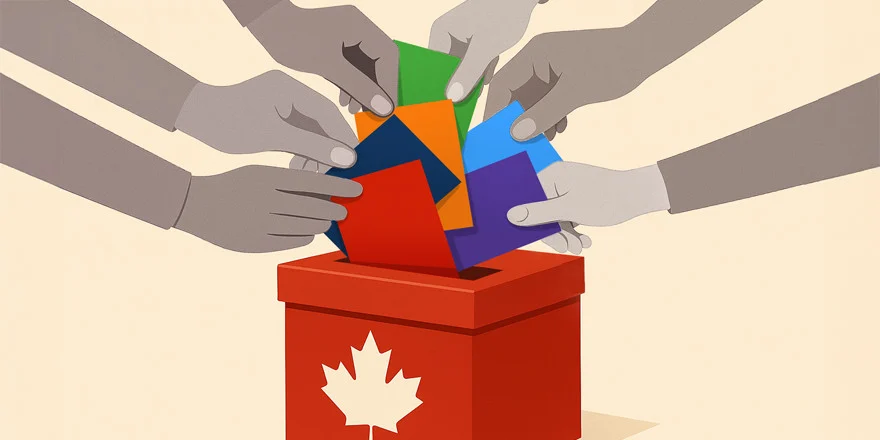
Sparknotes on who’s who so you can accurately fulfill your civic duty
By Lianne Ohayon, Associate Editor
On April 28th, Canadians will cast their ballots for a new Prime Minister. It is critical to be informed about who’s in the running, ensuring that you share your voice most effectively on the future of Canada.
Who can you vote for?
Five main parties could hypothetically seize the PM position: Liberal, Conservative, New Democratic Party, Bloc Québécois, and the Green Party. However, the two candidates at the forefront of the race are Liberal leader Mark Carney and Conservative leader Pierre Poilievre.
Liberal Party @ liberal.ca

Image Source: Artur Widak/NurPhoto via Getty Images
The incumbent ruling party, the Liberal party, represented Canada’s parliament under Justin Trudeau from 2015 to 2025. After Trudeau resigned this January, Mark Carney won a decisive majority in the election for a new Liberal leader. As the former governor of the Bank of Canada and later the Bank of England, Carney has never held public office before.
Carney’s political policies reinforce the sentiments of his party. Amid rising tensions with the U.S. due to President Donald Trump’s threats of making Canada the “51st state” and high tariffs on Canadian goods, Carney openly opposes and denounces Trump’s actions.
“His strategy is to break us so America can own us,” said Carney at a meet-and-greet in Hamilton, Ontario. “We are over the shock of the betrayal. But we should never forget the lessons.”
As UN Special Envoy for Climate Action and Finance, Carney is an adamant supporter of halting climate change, but not through the controversial carbon tax that Trudeau espoused. Instead, he aims to provide economic incentives for consumers who use energy-efficient products, promote the development of environmentally-friendly infrastructure, and ensure the largest polluters are held accountable.
Finally, in contrast to Trudeau-era Liberal policies of accepting a higher number of immigrants than in previous years, Carney wants to cap immigration until “sustainable pre-pandemic trends” are restored. He believes the current policy has enabled more newcomers to become permanent residents than the country can adequately support. However, Carney remains adamant on Canada being a place for immigrants to thrive. He also aims to promote the immigration of skilled workers to address the housing crisis, which would “supercharge Canada’s housing plan.”
Highlights of Liberal Election Promises
- Health care: expanded dental care to cover those aged 18-64, protect pharmacare, welcome internationally-trained professionals to fill shortages, invest in the North and its Indigenous and underserved populations
- Cost of Living: 1% tax cut on lowest income tax bracket, increase access to EI, eliminate the proposed hike to the capital gains inclusion rate
- Climate & Energy: cut consumer carbon tax, restrict industrial emitters, incentivize investment in clean energy (e.g. zero-emissions vehicle subsidy), open to energy projects and pipelines, eliminate fossil fuel use in government buildings
- Housing: cut GST for 1st time homebuyers on properties up to $1 million, $26 billion in debt/equity financing to “Canadian prefabricated home builders”
Conservative Party @ conservative.ca

The Liberal Party’s most significant challenger is the Conservative bloc. Their leader, Pierre Poilievre, rose significantly in popularity as Trudeau’s waned. Poilievre, born and raised in Calgary, was elected into parliament in 2004 at age 25, a position he has held since.
Poilievre’s stance represents a more refined version of a global trend towards right-wing populism. By promising to target the current Canadian government and elites, including “corporate Canada and Bay Street,” he attracts many working-class Canadians. Yet there are claims that corporate backers still maintain a weighty presence within the party, which may hold true for all major parties to varying degrees.
Poilievre opposes “woke” culture and embraced the “Freedom Convoy” back in 2021. Given the boisterous populism portrayed by Trump, Poilievre’s “soft populism” allows for a comparison between the two. The Conservative leader has since taken a firmer foreign policy stance to separate himself from the contentious American president, stating that “while Canadians are slow to anger and quick to forgive, once provoked, we fight back.”
On domestic policy, Poilievre endorses the reversal of Trudeau-era mandates, including cutting taxes and overall federal government reach. In addition to a desire to cut the federal carbon tax program (that Carney has done away with), he inclines to reverse other Liberal policies on climate change. The party also has not announced any carbon emissions reduction target. On housing, Poilievre wants to do away with Liberal progressivism, which he claims has caused higher inflation and more expensive costs of living. Finally, concerning immigration, Poilievre would adjust the number of newcomers based on the accessibility of new homes, health care, and jobs. He emphasizes the arrival of skilled workers to support Canadian industries and a cap on asylum seekers.
Highlights of Conservative Election Promises
- Health Care: retain federal dental/child/pharma care, eliminate supervised consumption sites, mandatory drug treatment for minors and prisoners with addiction
- Cost of Living: 2.25% tax cut on lowest income tax bracket, increase TFSA contribution by $5000 per year if invested in Canada, cut GST on Canadian-made vehicles
- Climate & Energy: repeal carbon tax, tax credits for businesses that reduce emissions, support an east-west pipeline and oil exports
- Housing: cut GST on new properties up to $1.3 million, tie federal funding to how many homes each city/municipality build to incentivize projects
New Democratic Party (NDP) @ ndp.ca

Image Source: Patrick Doyle/Reuters
The left-wing bloc, headed by Jagmeet Singh, attempts to contend with the overwhelmingly popular Liberals and Conservatives. Singh, who originally served as an Ontario MPP before assuming the role of NDP leader in 2017, is a practicing Sikh and first politician of an ethnic minority to lead a major federal party.
Despite originally supporting Trudeau’s leadership on shared party policies (i.e., national dental care and drug programs), the party turned on the ex-PM in 2022, claiming that the leader fell victim to corporate greed.
The NDP’s core tenets center around advocating for the everyday Canadian more strongly than the Conservative or Liberal parties do, ensuring that the ultra-rich and corporate leaders contribute their fair share to Canadian society. They fervently reject Trump-era American intimidation and policies, instead promoting a united front against the billionaire class.
Highlights of NDP Election Promises
- Health Care: expand pharma/dental/mental health care, end health care privatization, require provinces to seek federal funding to maintain health care standards, hire more nurses
- Cost of Living: raise untaxed income from $16,129 to $19,500, cut GST on essentials (energy, internet, phone bills etc.), increase & extend EI benefits
- Climate & Energy: remove carbon tax for consumers but not industries, cut oil/gas subsidies, prioritize east-west electricity grid, rebate for zero-emission vehicles
- Housing: $16-billion to construct affordable homes, use federal land to build rent-controlled units, restrict corporate landlords, low-interest public mortgages
Bloc Québécois @ blocquebecois.org

Image Source: La Presse Canadienne / Christinne Muschi
The Quebec sovereigntist party, who only runs candidates in federal ridings in Quebec, poses substantial opposition in the battleground province. The party’s leader, Yves-François Blanchet, is one of the province’s primary voices in Ottawa. Blanchet is staunchly opposed to the Trumpian tariffs and musings around Canada being a 51st state. By promoting a Quebec separatist agenda, Bloc Quebecois’ main goal is defining the province’s independence.
Highlights of BQ Election Promises
- Health Care: increase federal funding to cover 35% of Quebec’s health care costs
- Cost of Living: restrict credit card interest rates, double GST credits in quarters when inflation exceeds 1-3%, cut GST on second-hand goods
- Climate & Energy: compensate Quebec for carbon tax, oppose pipelines through Quebec, tax oil/gas industries to reinvest in climate friendly initiatives
- Housing: $1.2 billion of federal investment in Quebec housing, GST rebate for 1st-time homebuyers
Green Party @ greenparty.ca

Focusing on environmental rights, the Green Party is a small bloc co-led by Elizabeth May and Jonathan Pedneault. Despite having limited traction this election (causing them to be kicked from the candidates debate), the Green Party remains committed to their fight for climate justice, democracy, and equal rights for all.
Highlights of Green Party Election Promises
- Health Care: expand health insurance and mental health care, make medication free, improve access to reproductive and gender-affirming care
- Cost of Living: create a guaranteed livable income, make post-secondary education free, raise untaxed income to $40,000 for those earning less than $100,000, expand paid leave
- Climate & Energy: legally binding emissions reductions, eliminate public funding to oil/gas, invest in clean energy to supply the country with 100% renewable energy by 2035, reach net zero by 2050
- Housing: build 1.2 million affordable homes in next 7 years, restrict corporate real estate investments, strengthen rent and vacancy controls, increase funding for youth shelters and transitional housing
Vote!
We recommend that you check out each party’s official website for details on their platforms. CBC compiled a more comprehensive, side-by-side comparison of each party’s election promises. You can also stay updated on the latest polling results via 338canada.com or the CBC Poll Tracker.
Find out more on how to vote via www.elections.ca, so you can cast your ballot by April 28th. In addition to voting on the day of, advance voting and vote by mail options are available. Regardless of who you vote for, ensuring your voice is heard in your federal government is a critical civic duty.

