
A behind-the-scenes look at the history and planning of Trinity College’s Saints Ball 2025
Elizabeth Riddolls, Staff Writer

Photo Source: Danny Choi
A far cry from the cowboys that swept Trinity College’s Saints Ball last year, this year’s Saints was an elegant affair. The Phantom of Saints, organized by Adrian Lam and Divvy Gupta, was held on November 15th at The Great Hall, and brought with it a sophisticated evening of dancing, friendship, and laughter.
The event was based on Andrew Lloyd Webber’s Phantom of the Opera and was thus a masquerade ball, where attendees were offered a gold or silver mask to hide their faces. The deep blue and pink lighting filled the room with a mysterious atmosphere, and as you strolled along the balcony, you could almost imagine Christine Daaé singing like an angel down below.
Gentle piano music played as students walked into the venue, and after speeches by event organizers, the DJ amped up the music. I turned, grinning, to a friend as the quintessential organ riff from the musical began to play, and we began to jump.
As the night went on, the bass grew heavier, and I felt my ears begin to ache. Escaping to the adjacent hallway with my girlfriend in hand, we made our way to a quieter room with various food options scattered around.
The catering included mini poutines, jerk chicken, sushi, and other small hand-held treats, and we enjoyed them while appreciating the room’s gorgeous moulding. One table, stuffed with shortbread, cake, and cookies filled with sprinkles, was a popular site; I returned several times throughout the night. As the evening passed, I found myself in quiet conversation with friends, appreciating their company away from the hustle and bustle of the dance floor. Eventually, I curled up with my girlfriend in the turret in the corner of the room, and we watched the streetcars pass by in the night.
The Saints Ball has a complicated history, making its origins difficult to trace. Past Trinity Rolph-Bell Archivist Sylvia Lassam estimated it began sometime around the late 1930s or early 1940s, evolving from a yearly freshman dance and a formal for the graduating class held by juniors and sophomores. It was originally organized by the now-defunct St. Hilda’s College Meeting (SHCM), the St. Hilda’s College equivalent of the Trinity College Meeting. The Saints’ Ball Convenor was elected by the SHCM and was charged with organizing Saints, which was to be held on the Saturday before the Feast of St. Hilda on November 17.
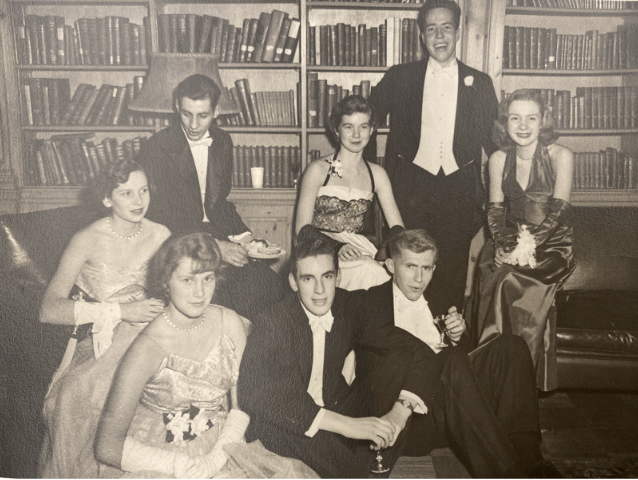
Students enjoying the 1951 Saints Ball. Photo Source: Trinity College Archives; Trinity Student Government Fonds F2329, 10-1-1, Saints Charity Ball, photograph and other materials, 1951
Early versions of the Saints Ball were semi-formal dances where the women of St. Hilda’s College asked the men of Trinity College to be their dates—a “Sadie Hawkins” dance. Sadie Hawkins dances were popularized in the late thirties, following the publication of a 1937 Al Capp comic strip that featured a young woman, Sadie, who was regarded as unattractive in her village. Worried she’d never be married, her powerful father decided to run a footrace where unmarried women could chase down all available bachelors and force them to marry them.
The misogynistic undertones of this comic strip are clear. Still, college women across the United States seized the concept as an opportunity to challenge gender norms and “get even” with the men who traditionally held the power in dating. In 1939, Life magazine reported that over 200 colleges across the country held Sadie Hawkins Day events. While unconfirmed, it’s likely that this “Sadie Hawkins craze” may have swept St. Hilda’s College and defined its girls-ask-guys character. While the source is unknown, the Saints committee reports that the first Saints’ Ball was held in 1939 in Melinda Seaman Hall, which aligns with this Sadie Hawkins’ timeline.
While this structure has been criticized today as heteronormative and non-inclusive to non-binary people who do not fit either role, it represented to some women the opportunity to flip the script. The tradition still holds in the modern Saints Ball, but it is not a strict rule.
When attending Saints this year as a lesbian couple, the gender norms that accompany this sort of event were certainly on our minds. Still, it was delightful to read about the experiences of women who experienced the Sadie Hawkins phenomenon in its prime: one source mentioned that “women especially enjoyed exploiting their power to cut in on the dance floor to torment young men who were used to holding the power to cut in on dancing pairs.”
For most of its history, then, Saints was an opportunity for students to experience “the whole routine… dinner, dance, coffee, drinks, hangovers,” to quote the 1974Trinity This Year freshman orientation guide. At some point in the past couple of decades, however, the focus of Saints shifted, as students began to reconceptualize Saints as a charity event. Over the years, Saints Ball committees have chosen causes to donate the event’s proceeds to, including Black Lives Matter Toronto and the AIDS Committee of Toronto.
This year, organizers Lam and Gupta decided to donate the proceeds to Partners in Health Canada (PIHC). This organization serves the world’s poorest communities, working with local governments and communities to address health threats by delivering high-quality healthcare and developing sustainable health systems and infrastructure. They explained their choice, expressing that PIHC reflected values of equity, community care, and a global focus that resonated with the organizing committee. Many students at Trinity, they knew, were passionate about medicine, global health, and social justice, and PIHC’s focus on strengthening public health systems and improving access to healthcare in underserved communities reflected the importance of these issues to the Trinity student body.
Operating on a $15,000 budget, organizing Saints involved carefully balancing budget limitations and affordability for students. Coordinating logistics, including the venue, transportation, catering, decor, security, volunteers and ticketing, was difficult, according to Lam and Gupta, but the moment when students walked into the room, spellbound, was incredibly rewarding. Without the tireless behind-the-scenes work of volunteers and committee members, they stressed, it would be impossible to put on such a successful event. Dedicated volunteers and committee members were willing to stay late, carry boxes, manage lineups, and solve problems on the fly, all the while bringing an enthusiastic spirit, emphasized Gupta. “Saints is a Trinity tradition, but it is also a student project in the best sense,” he wrote.
The Saints Ball, today, represents an opportunity for students to work together to produce a fantastic event, spend time together and build community, and engage with people and issues important to them. Although the mystery surrounding the origins of Saints remains unresolved and the ball’s aims have evolved over the years, the dance remains both a fond memory for past Trinity students and a special experience for present-day Trinity students.
Thank you to Adrian Lam and Divvy Gupta for their comments and their work, alongside the Saints Committee, in organizing Saints 2025. An additional thank you to Lindsay Grant, Rolph-Bell Archivist at the Trinity College Archives, for her help with archival research.

