
How the collision between climate change and public health systems reveals whose lives we prioritize in a crisis.
Tassneem Selman, Staff Writer
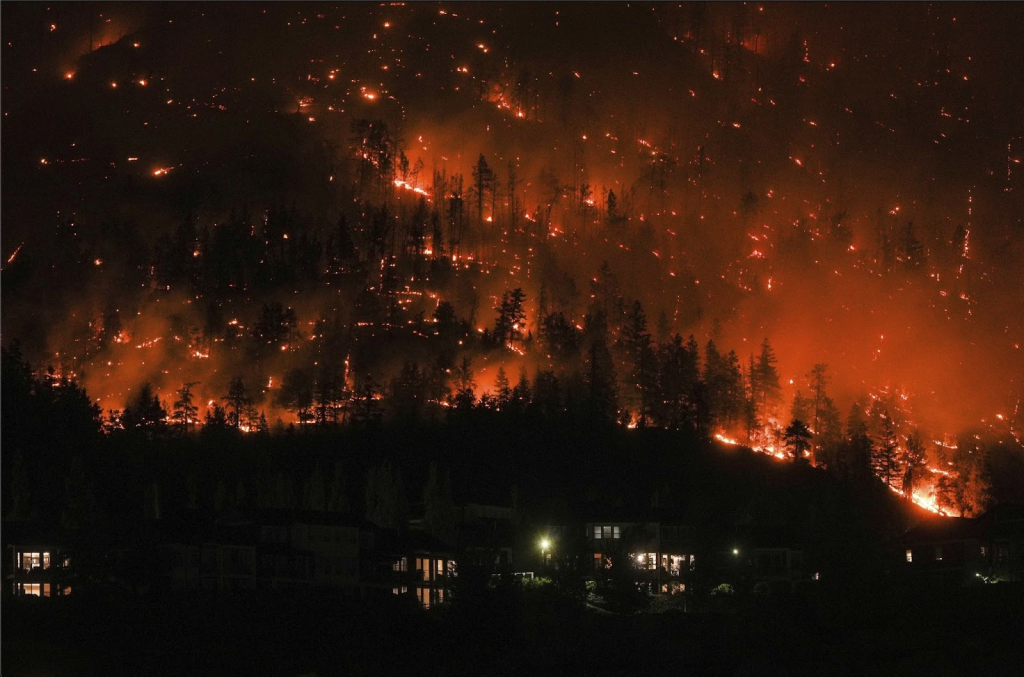
Photo source: Darryl Dyck/The Canadian Press, via Associated Press
Wildfires burn above homes in West Kelowna, B.C., in 2023.
WHEN DISASTER strikes, societies must respond with triage—rationing time, money, and manpower. While we often uphold the ideal that all lives carry equal value, real-world responses can fall short of that principle. In the face of crisis, some lives receive swift protection and care, while others are too easily overlooked.
This practice becomes evident during pandemics born from the spread of zoonotic viruses like COVID-19 or the Bird Flu. During the COVID-19 pandemic, those who needed the most protection—the elderly, the disabled, and marginalized communities—received the least of it.
And the kicker? Pandemics like COVID are expected to become more frequent. According to a 2022 Nature study, climate change and anthropological habitat loss are accelerating zoonotic spillover—the process by which viruses circulating in wild animals jump to humans. The researchers project over 4,000 new cross-species transmission events by 2070, with bats predicted to play a key role in disease transmission due to their adaptability and mobility. Undoubtedly, the strain of the increased frequency of pandemics on our public health systems will leave the most underserved communities without the protection they require, repeating the same moral transgressions seen during COVID.
This ecological shift is happening in real-time. As natural habitats dwindle due to development and environmental changes, wildlife is forced into closer proximity to humans. Take, for example, the sudden increased presence of foxes in UK urban areas. Due to habitat displacement, foxes—known transmitters of zoonotic diseases—are forced into metropolitan areas to survive.
What poses the greatest risk to human life: viral spillover or wildlife displacement? One could argue neither; rather, it is the pervasive, underlying philosophy that infects our entire public health system. The system that failed the public during COVID-19 upholds the same moral architecture that failed 300,000 indigenous Peruvians during the state-approved forced sterilization policy, Plan Verde. Public health reflects the values, priorities, and discrimination of the society that builds it. All disaster responses have a prevailing logic to explain the intentional patterns of neglect: protect the productive to stabilize the economy, while marginalized people absorb the aftershocks.
Eugenics is the unspoken answer to the question, “Who do we save?” when a society operates under triage for any disaster. Often tied to the discredited racial pseudoscience of the 20th century, its philosophy continues to permeate our public health framework today. As legal scholar Laura Appleman writes in her essay “Hiding in Plain Sight,” “[t]he COVID-19 pandemic has exposed the viral nature of eugenic philosophy, which has continued to guide U.S. treatment of the captive and vulnerable for over 100 years.” This philosophy justified several well-documented failures: rationing ventilators away from disabled patients, conducting experimental drug trials on institutionalized individuals without consent, and sending COVID-positive patients back into nursing homes to free up hospital beds. These missteps were not accidental nor isolated: they were the expected outcomes of a system built on the premise that some lives are expendable.
As the climate crisis intensifies, and disasters become more frequent, existing social inequalities will continue to shape who receives aid and who doesn’t.
Climate Change & Zoonotic Disease
As environmental collapse accelerates, it is becoming increasingly clear that pandemics are not purely random events; rather, they often emerge from the breakdown between ecological balance and strained public health systems.
A comprehensive 2025 study by Koren & Chaves (Oxford Academic) found that deforestation and land-use changes correlates with a 7% to 200% higher risk of zoonotic disease outbreaks, even after adjusting for socioeconomic factors such as conflict. Expanding agricultural and urban areas erode the natural buffers between humans and wildlife, pushing wildlife into closer contact with humans. Concurrently, the authors stress that ecological change is not the only critical driver of disease emergence: social, political, and economic systems are important contributors as well. These forces continue to silently drive biodiversity collapse and deepen structural inequality.
The connection between pandemics and economic systems that prioritize growth at the expense of ecological stability is no longer abstract—it is mathematically demonstrable. Using a dynamic model that links disease spread with economic and environmental systems, Researchers Brock & Xepadadeas (2020) demonstrated that increases in land-use change, GHG emissions, and economic growth non-linearly increases the spread rate of infectious diseases. In other words, small environmental disruptions can lead to disproportionately larger increases in epidemic risks. The message is clear: the more we pursue economic development at the expense of the environment, the more we amplify the conditions for future pandemics.
Eugenics and Public Health
Triage logic persists globally. Between 1996 and 2000, the Fujimori regime in Peru sterilized over 300,000 indigenous and rural women under Plan Verde. Framed as a public health initiative and economic modernization effort, Fujimori was able to use the program as incentivization for doctors to perform sterilizations under the guise of the “greater good.” Similar to other sterilization programs, Plan Verde was grounded in a neo-Malthusian worldview: the belief that reducing the birth rates of the poor is imperative to drive national development and preserve environmental sustainability.
As the climate crisis worsens, the eugenic logic behind Plan Verde is, scarily enough, far from dormant. It lingers in the white noise—behind calls for population control, climate migration crackdowns, and disaster responses that continue to quietly deprioritize and strategically undervalue the marginalized to protect the productive.
Let me be clear: climate change is a force multiplier. Every injustice or inequality will be felt more harshly by those already suffering under the crushing weight of unfairness. The discrimination built into the fabric of our societies will be intensified, revealing exactly who society never intended to protect.
Time and time again, we have seen this play out. There were over 600 casualties during the 2021 British Columbia heat wave. Predictably, the demographics that comprised most of those casualties were the elderly, disabled, and low-income individuals who either could not afford or could not physically add the infrastructure required to keep their poorly ventilated homes cool. It was not the heat that killed them—it was the lack of cooling centers, emergency planning, and the simple fact that their survival has been relegated, time and time again, as optional.
Wildfires are routinely expected in predictable regions of North America, and every year, evacuations occur. However, many people cannot afford to evacuate. Those who have the money, mobility, and place to go are the fortunate ones. The unfortunate must remain in the danger zone for reasons beyond their control. Instead of planning for those who can’t leave, the state builds its response around those who already can.
These outcomes reveal a real hierarchy of whose lives are worth expenditure, and whose losses are baked into the price we pay to keep our economic system running—quiet sacrifices unwillingly made to protect the broader system.
Climate change cannot be considered solely a geological phenomena because its social consequences are just as catastrophic. It roots itself within the fractures of our broken systems, revealing the facade of equality societies pride themselves upon.
Who are our systems built to abandon? Eugenics answers that question—falsely claimed as a relic, it has earned its place in our society as a quiet driver of inequality through triage, resource allocation, and institutional apathy. Those who feel protected must understand that their safety has often been secured through the blood and suffering of those deemed expendable.
Yet while climate change continues to expose the festering roots of injustice baked into our societies, that visibility concurrently offers a chance to cut out the rot at its source. We now face a choice: to continue to uphold a system that sacrifices—or to help build a new one that protects, unconditionally. Change always starts as a spark. It’s up to us now to decide whether we fan the flame, or let it die quietly.
Bibliography
Beginning:
- https://www.nature.com/articles/s41586-022-04788-w
- Citation: Carlson, C.J., Albery, G.F., Merow, C. et al. Climate change increases cross-species viral transmission risk. Nature 607, 555–562 (2022). https://doi.org/10.1038/s41586-022-04788-w
- JSTOR: Laura Appleman Article
- Citation: Appleman L. Hiding in plain sight: public health, eugenics, and COVID-19. HPHR. 2021; 30.
DOI:10.54111/0001/DD22
Climate Change & Zoonotic Diseases Research Papers:
- https://academic.oup.com/bioscience/advance-article/doi/10.1093/biosci/biaf045/8114226
- Citation: Ore Koren, Luis Fernando Chaves, The land-use land-cover change–emerging infectious disease nexus reconsidered, BioScience, 2025;, biaf045, https://doi.org/10.1093/biosci/biaf045
- https://link.springer.com/article/10.1007/s10640-024-00949-9
- Citation: Brock, W., Xepapadeas, A. Land Use, Climate Change and the Emergence of Infectious Diseases: A Synthesis. Environ Resource Econ 88, 795–854 (2025). https://doi.org/10.1007/s10640-024-00949-9
Eugenics and Public Health Article:

