
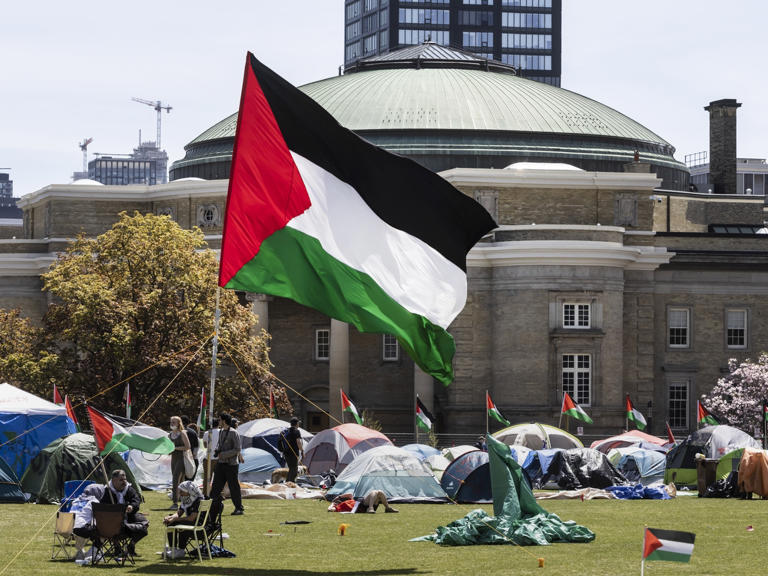
Pro-Palestinian Encampment in front of UofT’s Convocation Hall, May 2024.
Image source: Toronto Sun
Evaluating the Protests On-Campus and Beyond
By Jackie Walker, Staff Writer
This past year, students at the University of Toronto have been proactive in expressing advocacy in the face of adversity. From the CUPE protest in February to the pro-Palestinian protests and encampment in early May of this year, there has been a general increase in public protests throughout the University, the City of Toronto, and the nation as a whole.
Whether this is due to a rise in political unrest or simply a surplus of courage to challenge the status quo, it begs the question: have our intensified efforts to advocate for issues enacted real and lasting change?
Background
Why do people protest in the first place? And what are the limitations on protests?
Simply put, the purpose of protest is to demand change. The ability to protest only exists within democratic societies such as Canada. Canadians’ right to protest is derived from Section 2 of the Charter of Rights and Freedoms—primarily subsections b, c, and d—which covers freedom of expression, peaceful assembly, and association.
Interestingly, there is no expressed right in the Charter that allows protests. The ability and right to protest is, for the most part, regulated based on limitations of police powers. This means that larger-scale protests of any kind tend to break multiple laws. Due to this ambiguity, there is often misinterpretation regarding the appropriate extent of public protests and justifiable reasons for “shutting down” protest-related activities.
What makes a successful protest?
The Social Change Lab undertook six months’ worth of research on what makes a protest successful. They weighted factors such as diversity, number of protesters, nonviolence and more. They also considered the radical flank effect, which occurs when larger protest groups engage in extreme activities to the extent that smaller protest groups’ engagement in moderate tactics seem more reasonable.
The Social Change Lab found that the most effective protests include three main pillars. First is the utilization of nonviolent tactics, which has been shown to sway elected representatives most drastically compared to other approaches. Second is a favourable sociopolitical context. Less of a straightforward factor, this pillar is determinant on factors such as preexisting social opinion, media portrayals, supportive elites, and, frustratingly, luck. Third and finally, a greater number of participants in the movement can increase the chances of a successful protest.
Pro-Palestinian Protests at U of T
Most recently, we have seen these concepts manifest with the “Occupy UofT” movement earlier this year, which advocated for Palestine amid the Isreali-Palestinian conflict. Pro-Palestinian protesters camped at King’s College Circle for two months, requesting that U of T divest from companies profiting from Isreal’s offense in Gaza.
Eventually, a court order forced the protesters to disband their encampment. Despite the large protest size, seemingly nonviolent tactics, and favourable sociopolitical context, many U of T student protesters felt their voices were not being heard.
Erin Mackey, a spokesperson for the group, felt the university failed to listen to students.
“But ignoring us will make us go nowhere, we will continue to show up, we continue to demand divestment,” she said. “We will continue to show up day after day.”
Conclusion… or beginning?
From both research and student testimonials, protests can be effective in organizing a community that shares similar beliefs and bringing attention to issues that may not have been recognized by the public, governments, and various institutions, like U of T. The CUPE protest, for example, ultimately helped secure improved wages and benefits for workers at the University.
On a global or domestic level, the impact of protests, unless they are large and nationwide like the Black Lives Matter Movement, may initially appear to affect policies minimally.
However, any nationwide or global movement must begin somewhere.
And it could be here, as we show up day after day.
Works Cited
Anti-Bias Education. “The Purpose and Power of Protest.” www.adl.org, 12 June 2020, www.adl.org/resources/tools-and-strategies/purpose-and-power-protest. Accessed 9 Oct. 2024.
Beazley, Doug. “The Law on Protests.” Nationalmagazine.ca, 2024, nationalmagazine.ca/en-ca/articles/law/hot-topics-in-law/2024/the-law-on-protests. Accessed 9 Oct. 2024.
Grandy, Jake B., and Shon R. Hiatt. “The Radical Flank Revisited: How Regulatory Discretion Shapes the Effectiveness of Social Activism on Business Outcomes.” Organization Science, Institute for Operations Research and the Management Sciences, May 2023, https://doi.org/10.1287/orsc.2022.16104.
Paladin Risk Solutions. “A Steady Increase in Protests for 2024 – Paladin Risk Solutions.” Paladin Risk Solutions – Risk Mitigation Solutions for the Modern World, 5 Apr. 2024, paladinrisksolutions.com/safety-security-tips/a-steady-increase-in-protests-for-2024/. Accessed 9 Oct. 2024.
Raveendran, Rochelle. “Demonstrators at U of T Condemn ‘Repressive’ Protest Policies.” CBC, 6 Sept. 2024, www.cbc.ca/news/canada/toronto/u-of-t-protest-rules-1.7315867. Accessed 9 Oct. 2024.
Social Change Lab. “Protest Movements: How Effective Are They?” The Commons, 15 Mar. 2023, commonslibrary.org/protest-movements-how-effective-are-they/. Accessed 9 Oct. 2024.
The Canadian Press. “Pro-Palestinian Protesters Leave UofT Encampment ahead of Court-Ordered Deadline.” Global News, 3 July 2024, globalnews.ca/news/10601515/university-toronto-encampment-judge-order/. Accessed 9 Oct. 2024.

