
What the Firehawk Debate Reveals About Indigenous Knowledge
Saanvi Mazumdar, Staff Writer
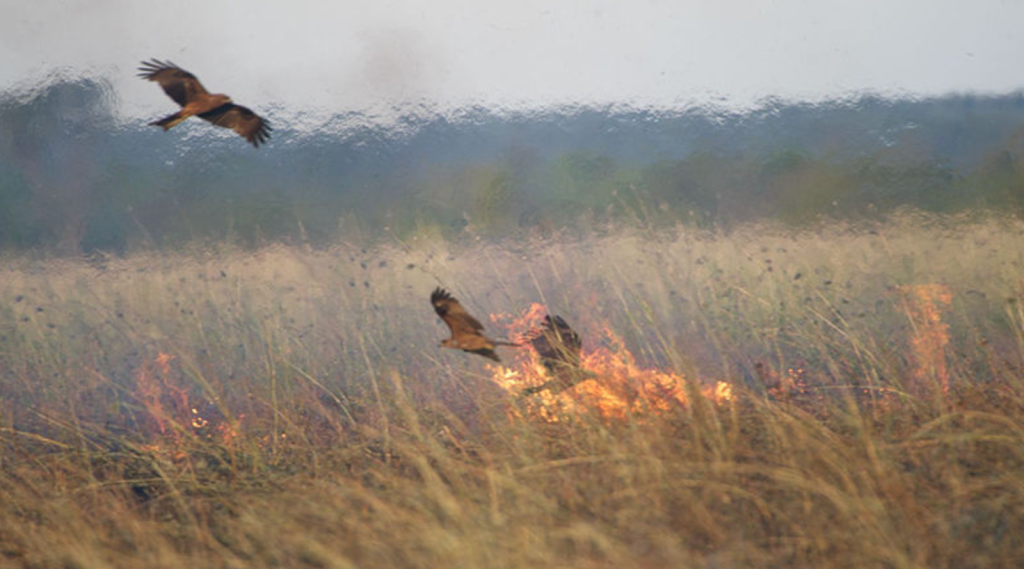
Image Source: Researching Firehawks
The use of fire has long been recognised as one of the defining skills of human beings, alongside toolmaking and art. Yet humans are not the only species to harness fire for its benefits.
For generations, Indigenous groups in northern Australia have observed that raptors hunt in and around active fires. The connection between birds and fire is a recurring theme in Aboriginal mythologies, where birds are described as using flames to flush out prey such as insects and small animals. Since then, these were long dismissed as mere stories; however, recently, these accounts have been supported by scientific studies, revealing that they hold significant ecological truth.
According to Indigenous worldviews, fire is far more than a destructive force. It is a tool for regeneration, balance, and renewal. Within their systems of knowledge, cultural burning is a long-standing practice that sustains biodiversity, maintains landscapes, and reduces the risk of severe wildfires. In this context, the fire-spreading behaviour of raptors, often called firehawks, fits naturally. Rather than being seen as unusual, it is understood as part of the unique patterns within nature. For Indigenous communities, this behaviour was neither new nor surprising.
For years, they have observed species such as black kites, whistling kites, and brown falcons gathering around fires. These birds pick up burning sticks with their beaks or talons and carry them into grasslands or dense areas where prey is abundant. The advancing fire drives small animals from their hiding places, giving the raptors an ideal opportunity to hunt. In doing so, the birds work with nature’s forces to their advantage—something Indigenous peoples recognized long ago. Some researchers have even suggested that these observations may have inspired Indigenous practices of using fire deliberately in their own land management.
In 2017, the Journal of Ethnobiology published an article describing the fire-spreading behaviour of so-called firehawks. It was the first Western scientific paper to formally document the phenomenon. While the study included some observations of raptor behaviour and acknowledged that the idea may have circulated earlier, it ultimately presented the knowledge as a scientific discovery. It did not meaningfully credit the Indigenous peoples who had long understood and documented this behaviour. This omission reinforced a broader pattern: knowledge only becomes “valid” when framed through a Western lens, while knowledge systems rooted in different traditions are marginalized. By sidelining the cultural and ecological significance of Indigenous accounts, the article and society at large perpetuated the notion that Indigenous voices are less authoritative and, to an extent, dismissible. For Indigenous communities, however, these observations are not abstract science—they are living cultural practices.
One reason Western audiences may struggle to imagine how non-human animals can use fire in such complex ways is a broader disconnection from the natural world. Many societies have chosen to insulate themselves in urban environments, severing ties with the ecological relationships that once shaped human existence. In contrast, Indigenous communities continue to live in close connection with their land, using that as a foundational relationship between knowledge and practice.
Indigenous knowledge may not always have empirical evidence, often demanded by Western science, but that does not make it less rigorous or less true. Instead, it actually reflects a different way of producing and transmitting knowledge—one that values observations, lived experience, and cultural continuity alongside ecological insight.
One of the authors of the 2017 paper remarked that he hoped “people are more willing to accept it now that they see our fine-grain descriptions.” Even if it was meant as a compliment to the depth of Indigenous knowledge, the statement highlights a frustrating reality: ideas usually gain visibility and ultimately legitimacy only when it is validated by Western science. Unfortunately, this is not just an isolated case. Across fields—whether it is knowledge about nature, cultural practices, skincare, clothing, or other traditions—practices rooted in non-Western communities often become a global sensation only after colonial appropriation.
The firehawk debate raises urgent questions about power, equity, and scientific collaboration. Who has the authority to define what counts as a discovery? How can research methods be restructured to meaningfully incorporate and credit Indigenous cultural knowledge? Why must Indigenous observations wait for Western validation before being recognized as legitimate?
This debate is crucial because it highlights recurring injustices faced by minority groups in academia. The firehawk debate is not just about the remarkable behaviour of birds—it is about how societies choose to recognize and value different ways of knowing. To move forward, scientific communities must confront their biases and actively remove the structures that neglect Indigenous knowledge. True progress will need more than just a token acknowledgement; it requires equitable partnerships, co-authorship, and respect for Indigenous intellectuality.

