
Improving Water Conservation in Canada
Eliza Demirkıran, Staff Writer
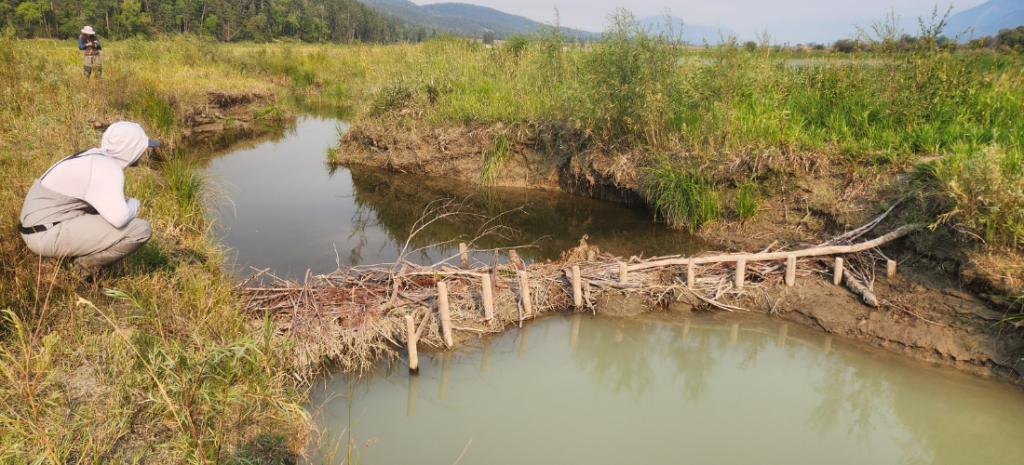
Living Lakes Canada’s Braeden Toikka looks onto a human-made beaver dam. Catriona Leven/CWSP photo.
Over generations, traditional knowledge keepers have developed methods to conserve water, a sacred being, that balance human needs with ecological sustainability. Although these practices were often overlooked by the colonizing power, their effectiveness is receiving growing recognition. Modern efforts are combining Indigenous knowledge with modern-day science and engineering to preserve Canada’s freshwater systems.
Indigenous knowledge has always considered water as a living relative rather than a source. Communities governed water collectively, with the understanding that what was used must also be protected for future generations. Across the country, diverse practices show how advanced these systems were, such as fishing weirs. Fishing weirs were built from stone or wood to guide salmon and other fish into harvesting areas without destroying populations. These structures, used for generations by Mi’kmaq and Coast Salish people, provided food security while ensuring river ecosystems remained healthy. Today, scientists study these designs as inspiration for sustainable harvesting practices.
Indigenous communities have long recognized the critical importance of beaver-created wetlands to healthy watersheds, making these ecosystems equally significant to conservation efforts. Beavers act as natural engineers; their dams slow flooding, trap sediments, filter pollutants, recharge groundwater, and provide habitats for countless species. The widespread trapping of beavers during the fur trade devastated these natural systems, but their ecological value is now being restored. In fact, modern conservation projects and engineering models increasingly point to beaver wetlands as examples of low-cost, highly effective flood control and water purification.
Other regions have developed methods adapted to their unique environments. In British Columbia, terraced irrigation helped regulate water flow across steep landscapes, preventing erosion and conserving soil moisture. In the North, Inuit communities crafted snow and ice storage systems to ensure reliable water and food preservation in extreme climates. Each practice reveals a careful balance between human survival and ecological integrity, a balance modern Canada continues to struggle with. A major shift is occurring as Indigenous perspectives on water governance enter legal and political systems. In 2021, the Magpie River in Quebec (Muteshekau Shipu) became the first river in Canada to be granted legal personhood!
Recognized by the Innu Council of Ekuanitshit and the local municipality, the river now holds rights such as maintaining its natural flow, being free from pollution, and sustaining biodiversity. This landmark decision reframes environmental protection by placing ecosystems themselves at the centre of law, a concept rooted in Indigenous worldviews that understand water as a living entity rather than a resource to exploit. Beyond legal recognition, Indigenous communities continue to practice stewardship on the ground.
Community-based monitoring programs, often led by youth and elders together, track water quality and ecological changes in rivers and lakes. These programs provide valuable scientific data while empowering communities to take control of local conservation. They are not only tools for environmental management but also a way to strengthen cultural connections to the land and pass knowledge to future generations. Restoration projects also play a vital role: Indigenous groups have revived salmon and trout habitats that were devastated by industrial development and climate change, combining traditional ecological knowledge with modern techniques such as streambank stabilization and habitat reconstruction. These efforts demonstrate that restoration is both scientific and cultural, reconnecting communities with their waters while repairing ecosystems.
Advocacy is another powerful force in Indigenous water governance. Legal battles and political campaigns continue to demand recognition of water rights and responsibilities. Some modern treaties explicitly address water management, establishing shared responsibilities with federal and provincial governments. In December 2021, the Assembly of First Nations passed Resolution 41/2021, urging Canada to support the creation of Marine Indigenous Protected and Conserved Areas, or IPCAs. These coastal conservation zones, led by Indigenous nations, aim to protect waters from industrial exploitation while supporting sustainable livelihoods. To advance this work, the AFN Water Sector created a sub-working group that develops strategies for balancing marine conservation with Indigenous leadership. These initiatives highlight how Indigenous governance can shape national policy while protecting ecological systems.
Despite these successes, challenges remain. Many communities face serious threats to their water from industrial projects such as pipelines, mining, and artificial dams. Jurisdictional disputes between different levels of government make protecting these ecosystems even more difficult. Meanwhile, long-term water insecurity continues to plague communities across Canada. As of 2024, dozens of First Nations were still under boil water advisories, some lasting decades. These advisories mean residents cannot safely drink from their taps, a basic service most Canadians take for granted. The persistence of such inequities underscores the need for urgent action. Indigenous-led water governance cannot simply be acknowledged symbolically; it must be supported materially and politically.
The relevance of these approaches has only grown as climate change accelerates. Canada is already experiencing more frequent droughts, floods, and unpredictable weather events, putting pressure on existing water systems. Indigenous practices, with their emphasis on working with natural processes rather than against them, provide long-lasting solutions. Fishing weirs demonstrate how engineering can align with ecosystems. Beaver wetlands show how biodiversity itself can manage floods and store water. Traditional governance frameworks offer models of collective responsibility that emphasize equity and interdependence.
Scientists and engineers are increasingly recognizing this. Green infrastructure projects, such as wetland restoration and riverbank stabilization, often reflect practices Indigenous peoples have used for centuries. When knowledge keepers and researchers collaborate, they achieve a fuller understanding of ecosystems and how to protect them. These partnerships represent reconciliation in action, where Indigenous wisdom is not just respected as heritage but applied as a practical tool for solving modern crises, which is crucial to honour the land.
The story of Indigenous water governance is therefore not just one of the past, but it is one of the present and the future. It shows that ‘ conservation is most effective when rooted in reciprocity and respect, not simply regulation’. It reminds us that water must be cared for collectively, across generations, rather than exploited until it runs out. As Canada grapples with climate change, biodiversity loss, and persistent inequalities in water access, the path forward is clear: embrace Indigenous-led approaches, support community-based stewardship, and embed traditional knowledge into engineering and policy.
As Indigenous communities realized thousands of years ago, water is more than a source granted to humans; it is a living relative, a sacred presence, and a foundation of life. By protecting it in partnership with Indigenous nations, Canada can build a future where water is not only safe and accessible for all but also honoured as the lifeblood of ecosystems and cultures alike.

